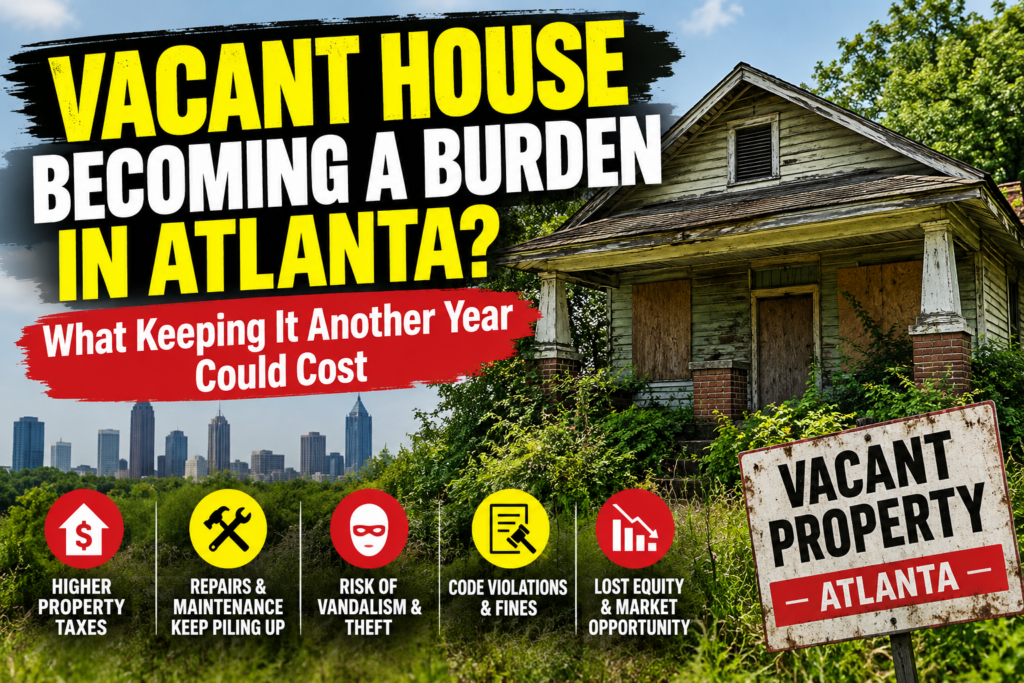
A vacant house doesn’t have to stay your responsibility forever. If you own an empty house in metro Atlanta and aren’t sure whether to fix it, sell it, or keep waiting, you can make the decision clearer by comparing four things: what the house will keep costing you, what you’re likely to net from each option, how much time and involvement each path takes, and whether any ownership or title issues need to be resolved first.
It’s also fair to admit that “I don’t want to manage this anymore” is a legitimate reason to make a change. Your time and peace of mind count, too.
This guide walks you through a simple worksheet for your monthly costs, a clearly labeled example, a side-by-side look at your options, and a checklist you can work through this week.
How an Empty House Becomes an Ongoing Obligation
Most owners don’t set out to keep a house empty for years. A parent passes away, a tenant moves out, a job takes you to another state, and the house sits while life moves on. Meanwhile, the bills keep arriving.
It helps to separate costs into two groups.
Predictable, recurring costs
- Property taxes. These are due whether or not anyone lives in the house.
- Insurance. Many standard homeowners policies treat a vacant or unoccupied house differently from an occupied one. Ask your insurer or agent how vacancy affects your specific coverage, and don’t assume you’re covered.
- Mortgage payments, if the house still has a loan. Many inherited and long-held houses don’t.
- Utilities. Some owners keep power or water on for security lighting or to protect the house, but only when the systems are in safe condition. Don’t restore utilities to a damaged building without advice from a licensed professional.
- Lawn care and exterior upkeep. Overgrown yards and debris can draw complaints or code attention.
- Security and property checks. Someone may need to drive by, check locks, and look for leaks or break-ins.
- Travel or management expenses, especially if you live outside the area.
Uncertain, one-time costs
Repairs are harder to predict. A roof leak, a burst pipe, foundation movement, or failing HVAC may be years away or already underway. Older or long-empty houses often hide problems that only show up once a contractor opens a wall. These costs belong in a separate column, which the worksheet below sets up.
Not every vacant house has a mortgage, a code violation, or an insurance problem. The point is to know which of these costs apply to your house.
Worksheet: What Does Your House Cost Each Month?
Fill in your own numbers. If you only have an annual figure, such as a tax bill or a yearly insurance premium, divide it by 12 for the monthly column.
| Recurring expense | Monthly amount | Annual amount | Where to verify the figure |
| Property taxes | $________ | $________ | Your most recent tax bill or your county tax commissioner |
| Insurance | $________ | $________ | Your policy declarations page or insurer |
| Mortgage payment (if any) | $________ | $________ | Your monthly mortgage statement |
| Utilities | $________ | $________ | Recent utility bills |
| Yard care | $________ | $________ | Your lawn service invoices |
| Property checks or management | $________ | $________ | Your property manager, neighbor, or travel receipts |
| Other recurring expenses | $________ | $________ | HOA dues, registration renewals, security service, etc. |
| Total recurring cost | $________ | $________ |
Then calculate:
- Monthly carrying cost = your total recurring monthly expenses
- Six-month carrying cost = monthly carrying cost × 6
- Twelve-month carrying cost = monthly carrying cost × 12
Two adjustments to avoid double-counting
Escrowed taxes and insurance. If your mortgage payment already includes property taxes and insurance through an escrow account, don’t list those costs again on their own rows. Count them once.
Mortgage principal. A mortgage payment affects your monthly cash flow, but not all of it is a permanent loss. The interest portion is a cost. The principal portion reduces the debt you owe, which generally shows up later as a smaller payoff when you sell. When you compare options, it’s reasonable to track the full payment for cash-flow purposes while remembering that principal isn’t money that disappears.
One-time repairs (keep these separate)
| Repair item | Estimated cost | Source of estimate |
| $________ | Contractor quote, inspection report, etc. | |
| $________ | ||
| $________ | ||
| Total estimated repairs | $________ |
Rough figures are fine at this stage. A written contractor estimate or a pre-listing inspection will give you firmer numbers if you’re seriously considering repairs.
A Hypothetical Example
These figures are hypothetical and are not Atlanta market averages. They’re round numbers chosen only to show how the math works. Your house’s actual costs could be much higher or lower.
Imagine a paid-off house with no mortgage:
| Hypothetical recurring expense | Monthly | Annual |
| Property taxes | $200 | $2,400 |
| Insurance | $150 | $1,800 |
| Utilities (kept on minimally) | $50 | $600 |
| Yard care | $75 | $900 |
| Property checks | $50 | $600 |
| Other | $25 | $300 |
| Total | $550 | $6,600 |
In this example, six more months of ownership costs $3,300 and twelve more months costs $6,600, before any repairs.
That number alone doesn’t prove you should sell now. If repairs would substantially increase the sale price, or if you plan to keep the house for family use, holding may still make sense. What the worksheet does is put a real price on waiting, so you can weigh it honestly against the alternatives.
Repair, Hold, List As-Is, or Sell Directly?
There’s no single right answer. Each path trades money, time, and involvement differently.
| Option | Upfront cash needed | Owner involvement | Potential advantage | Main tradeoff | When it may fit |
| Repair and keep | Moderate to high | High and ongoing | Keeps the property in the family or as a rental | Continued costs, repairs, and management | You have funds, time, and a clear use for the house |
| Repair and list | Moderate to high | High during repairs and listing | May produce the highest sale price | Repair risk, contractor coordination, and months of carrying costs | The house needs mostly cosmetic work and you can manage the project |
| List as-is | Low | Moderate | Reaches a broad pool of buyers without renovating | Inspections, renegotiation, financing limits, and uncertain timing | The house is in fair condition and you can wait for the right buyer |
| Sell directly as-is | Low | Low | No repairs, showings, or agent commission, plus a set closing date | The price is usually lower than a successful retail sale | You want simplicity, certainty, or a faster exit |
A few points worth keeping in mind:
- Direct buyers price in their costs. Any company that buys houses directly, including ours, factors repairs, transaction costs, holding costs, risk, and a return into its offer. That’s why a direct offer usually comes in below what a fully updated house might sell for.
- As-is listings aren’t hands-off. Listing as-is can expose the house to more buyers, but buyers may still inspect, renegotiate after inspection, or struggle to get financing on a house in rough shape.
- Commissions vary. Real estate commissions aren’t fixed and are negotiable. If you’re considering a listing, ask agents for a written estimate of all selling costs.
If you’re dealing with a house that has been empty for a long time, our page on selling a long-vacant or abandoned house in Atlanta covers the as-is route in more detail.
Compare What You May Net, Not Just the Offer Price
It’s easy to compare headline numbers. It’s more useful to compare what you would actually walk away with. Four terms get mixed up often:
- Asking price: what a seller lists the house for. It’s a starting point, not a result.
- Possible sale price: what the house might realistically sell for, based on condition and comparable sales.
- Written offer: an actual price and set of terms from a specific buyer.
- Estimated net proceeds: what you’d likely receive after everything is paid at closing.
Use this simplified framework for each option you’re considering:
| Line item (estimates) | Option A: ________ | Option B: ________ |
| Expected sale price | $________ | $________ |
| Minus transaction expenses (commission, closing costs) | – $________ | – $________ |
| Minus repairs or negotiated credits | – $________ | – $________ |
| Minus carrying costs until closing | – $________ | – $________ |
| Minus mortgage payoff and other amounts owed | – $________ | – $________ |
| Estimated net proceeds | $________ | $________ |
Count each cost only once. For example, if a buyer’s offer already accounts for repairs, don’t subtract repair costs again on that line. Carrying costs should cover only the months until that option would realistically close.
Tax consequences are separate from this calculation and depend on your situation, such as whether the house was inherited or used as a rental. A qualified tax professional can explain how a sale may affect you.
What If There Are Back Taxes, Code Notices, or Ownership Problems?
Complications are common with long-vacant houses, and they don’t necessarily prevent a sale. This is general information, not legal advice.
- A neglected house isn’t automatically condemned. Condemnation is a specific legal action by a government agency, not just a description of a house’s condition.
- “Abandoned” doesn’t mean ownership has disappeared. The owner of record, or that owner’s estate, still owns the house until it’s legally transferred.
- Title still has to be reviewed. Any buyer, including a direct buyer, needs a title company or closing attorney to confirm who can sign and what’s owed.
- Being an heir isn’t the same as having authority to sell. If the owner has died, someone usually needs legal authority, often through the probate court, before signing for the estate.
- Debts can reduce your proceeds. Back taxes, liens, and mortgage balances are generally paid from the sale at closing.
- A proposed sale doesn’t stop the clock. Talking to a buyer or signing a contract doesn’t automatically pause a tax sale, code enforcement deadline, or other official process.
If you’ve received a notice, contact the agency listed on it directly. For estate questions in Fulton County, the Fulton County Probate Court is a starting point. The Georgia Heirs Property Law Center and Atlanta Legal Aid Society help eligible families with inherited-property and title issues. If the house was inherited, you can also compare your options for an inherited house in East Point. That guide is written for East Point, so local offices and rules may differ where your house is.
Atlanta Address or City of Atlanta Property?
An “Atlanta” mailing address doesn’t necessarily mean your house is inside the City of Atlanta. Atlanta addresses cover parts of several counties, unincorporated areas, and separate cities with their own rules.
That matters because registration requirements, code enforcement, and some property taxes depend on the jurisdiction, not the mailing address. For example, the City of Atlanta has its own vacant property registration process, but that rule doesn’t apply to a house in unincorporated DeKalb County or in a different city just because the address says “Atlanta.”
The clearest way to check is your property tax bill, which shows the tax district. You can also look the property up through your county tax office, such as the Fulton County Tax Commissioner or the DeKalb County Tax Commissioner.
To check which vacant-property registration rules apply in different parts of metro Atlanta, see our registration guide. If your house is in a separate city like East Point, Decatur, or Forest Park, those pages cover local details for owners there.
A Practical Next-Seven-Days Checklist
This is a plan for getting organized, not a sales timeline. If you have an urgent official deadline, deal with that first rather than waiting until the end of the week.
- Confirm the property address and parcel number using your tax bill or county records.
- Identify every owner and anyone with authority to make decisions, such as co-owners, heirs, or an estate representative.
- Gather tax bills, mortgage statements, and any official notices.
- Check whether the house is insured and how the policy handles vacancy.
- Document known condition issues with photos or notes, without entering any area that seems unsafe.
- Fill in the worksheet above to calculate your recurring costs.
- If you’re considering renovation, get at least one realistic repair estimate.
- Ask a local agent what an as-is listing might look like, including likely price, timing, and costs.
- If a direct sale is on the table, request a written offer.
- Compare timing, estimated net proceeds, and how much work each option requires of you.
Frequently Asked Questions
Can I sell a house that has been vacant for years?
Yes. Length of vacancy doesn’t prevent a sale. What matters is who owns it, what’s owed against it, and its condition, all of which affect price and timing.
Do I need to repair or clean out an abandoned house first?
Not necessarily. Some buyers purchase houses as-is, with belongings and debris still inside. If you sell that way, the purchase agreement should state in writing who is responsible for removing what’s left. If you list with an agent, cleaning and some repairs may help, but they’re a cost to weigh.
What if I live outside Georgia?
You can usually sell from out of state. Much of the process can happen by phone and email, and title companies and closing attorneys regularly arrange remote or mail-away signings. Requirements vary by closing office.
Can I sell if I owe more than the offer covers?
It’s possible, but an ordinary sale doesn’t automatically resolve a shortfall. The mortgage and other liens generally have to be paid at closing, so you may need to bring money to closing or negotiate with the lender. A real estate attorney or HUD-approved housing counselor can explain your options.
What if several relatives own the house?
Generally, everyone with an ownership interest, or someone with legal authority to act for them or an estate, needs to agree and sign. Disagreements or missing heirs can delay a sale. Legal help can be worth it here.
Does selling as-is mean there’s no inspection or property review?
No. “As-is” usually means you won’t make repairs. Buyers still typically look at the house, in person or through photos, and a title company still reviews ownership and debts.
Is it better to wait for the market to improve?
No one can reliably predict future prices. Waiting might bring a higher price, or it might not, and the house keeps costing money in the meantime. Your twelve-month carrying cost from the worksheet is a useful number to set against any price increase you’re hoping for.
What information should I gather before requesting an offer?
The address, who owns the house, how long it’s been empty, known repair problems, mortgage or lien balances, tax status, and any official notices. If you don’t know some of these, that’s fine. Say so.
You Don’t Have to Have Everything Figured Out Before You Call
If a direct sale is one of the options you’re weighing, we’re glad to talk it through. Atlanta Vacant House Buyers buys vacant and unwanted houses as-is across metro Atlanta, and we’ll explain how we arrive at any offer so you can compare it with your other choices.
It helps to share:
- The property address
- How long the house has been empty
- Any condition issues you know about
- Your connection to the property, such as owner, heir, or representative
- Any official deadlines or notices
Call Gerald at (404) 913-7086 to discuss whether a direct sale makes sense for your situation. There’s no obligation to accept an offer, and if another route would serve you better, we’ll tell you.
Calling us doesn’t pause any official deadline, so keep responding to any agency that has contacted you. To learn more first, see how our buying process works, read about who we are, or visit our homepage.
Contact Us
We would love to hear from you! Please fill out this form and we will get in touch with you shortly.